Work and economy
Commuting from Ocala to Gainesville
Marion County housing with an Alachua County job is a recognised pattern rather than a clever trick. It is also an hour of your life every weekday, forever.
Bottom line
- About 37 straight-line miles between the two cities, computed from Census Gazetteer internal points. The road route up Interstate 75 or US 441 is longer, and the drive is the reason the pattern exists at all.
- The trade is explicit: Marion County's median home value is $243,100 against Alachua's $288,800, and Alachua has the jobs Marion County does not — 48.8 percent of its adults hold a bachelor's degree against 23.4 percent here.
- Two routes, two personalities. The interstate is faster and worse when it goes wrong; US 441 is slower, more direct to some destinations, and rarely stops entirely.
This is the commute that makes Marion County's housing market work for a chunk of its population, and it deserves an honest accounting rather than an enthusiastic one.
The distance
About 37 straight-line miles between Ocala and Gainesville, computed from the Census Bureau's 2024 Gazetteer internal-point coordinates. That is a great-circle figure; the road route is longer and the drive time depends on which end of each city you are going between.
For scale, that is further than Marion County's internal distances — Marion Oaks is 12 miles from Ocala and Dunnellon is 18 — and shorter than Ocala to Orlando at 76 or Tampa at 86.
Why the pattern exists
Two counties, thirty-odd miles apart, with complementary problems.
| Marion County | Alachua County | |
|---|---|---|
| Median value, owner-occupied home | $243,100 | $288,800 |
| Median gross rent | $1,277 | $1,339 |
| Owner-occupancy rate | 77.5% | 54.1% |
| Bachelor's degree or higher, 25+ | 23.4% | 48.8% |
| Mean travel time to work | 26.8 min | 21.8 min |
Alachua County has a large public university, a teaching hospital and the research economy around them. Those produce jobs that Marion County simply does not have — the Ocala metro's entire information supersector is 700 jobs, and academic and clinical research employment is concentrated up there.
Marion County has cheaper housing, more of it owner-occupied, and a great deal more land.
So a household with an Alachua County job and a preference for a house with a yard solves the problem by refusing to choose. Ocala vs Gainesville sets the two counties side by side in full.
The two routes
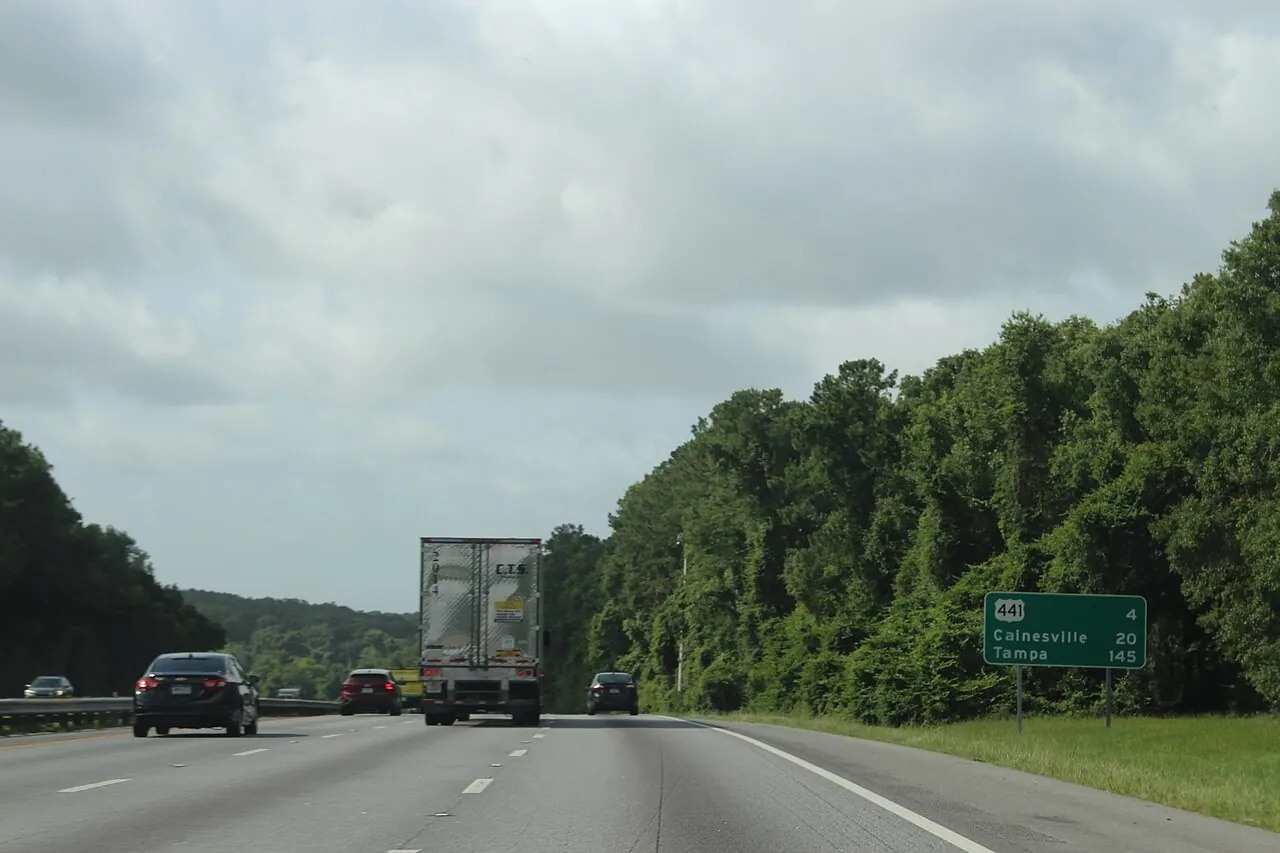
Interstate 75. The default. Faster in ordinary conditions, limited access, and genuinely bad when something goes wrong, because there is nowhere to go and the next exit may be several miles away. Construction on this corridor is more or less permanent, in the sense that there is always some of it somewhere.
US 441. Runs roughly parallel, slower, with traffic lights and towns along it. It is more direct to some parts of Gainesville, and — the important part — it keeps moving when the interstate stops.
People who make this drive every day know both and choose in the morning. If you are considering the commute, drive both, in both directions, at the times you would actually travel. That hour is the best research you can do on this decision.
What it actually costs
The time is obvious. The money is the part people leave out of the housing comparison.
A round trip of roughly 74 straight-line miles a day — more by road — every working day is a real annual expense in fuel, tyres, servicing and depreciation, and it falls on a vehicle that is aging faster than a non-commuting one. Before you conclude that a $45,700 difference in median home value is free money, work out that number for your own car and subtract it.
Two further considerations:
If two people in the household commute to Alachua County, you are paying the time and the vehicle cost twice, and the arithmetic often stops working.
There is no transit option. Nothing runs between the two counties that functions as a daily commute. This is a car commute in every practical sense, and if a household vehicle is off the road, so is the job.
Who it works for
Descriptively:
- One commuter, one local or remote worker. The strongest version. One household pays the drive; both get Marion County housing.
- People who genuinely do not mind driving. Some people find forty minutes of radio or a podcast to be the best part of the day. If that is you, this is a very good deal.
- Anyone with hybrid or compressed-week arrangements. Two or three days a week changes the arithmetic completely and is the single biggest thing that has made this pattern more workable than it used to be.
And who it does not:
- Two full-time Gainesville commuters, for the reasons above.
- Anyone with a schedule that cannot absorb a bad traffic day, which on this corridor arrives without warning.
- Anyone who would be doing it in a vehicle that cannot take the mileage.
The honest summary
It is a real and ordinary commute that a lot of people make, in a county where the average commute is 26.8 minutes and this one is considerably longer than that.
The housing gap that pays for it is genuine but not enormous — about 16 percent on median home value. What actually makes the pattern attractive for most people who do it is not the money; it is the land, the quiet, and the difference between a university town's housing market and a rural county's.
Drive it before you sign anything. Twice, at the times you would really be on the road.
Sources
- U.S. Census Bureau — 2024 Gazetteer Files, Florida places — internal point coordinates for Ocala and Gainesville, from which the 37-mile straight-line distance is computed. Great-circle miles, not road miles (retrieved September 18, 2026)
- U.S. Census Bureau QuickFacts — Marion County and Alachua County — Marion County median home value $243,100, median gross rent $1,277, mean travel time to work 26.8 minutes; Alachua County $288,800, $1,339, 21.8 minutes and 48.8 percent bachelor's degree or higher against Marion's 23.4 percent. ACS figures are 2020-2024 five-year estimates in 2024 dollars (retrieved September 18, 2026)
- U.S. Bureau of Labor Statistics — State and Metro Area Employment, Ocala FL MSA — Ocala metro total nonfarm employment 125,600 in July 2026, with information employment at 700 — the reason some careers commute (retrieved September 18, 2026)
- Florida Department of Transportation — the agency responsible for Interstate 75 and US 441, including construction and lane closures (retrieved September 18, 2026)
- Florida Department of Transportation — traffic data — published traffic counts and corridor statistics (retrieved September 18, 2026)
Common questions
How far is Ocala from Gainesville?
About 37 miles in a straight line, computed from the Census Bureau's 2024 Gazetteer internal point coordinates for the two cities. The road distance up Interstate 75 or US 441 is longer, and the drive time depends on which end of each city you are travelling between and when.
Is the Ocala to Gainesville commute worth it?
It depends on the gap it buys you. Marion County's median home value is $243,100 against Alachua County's $288,800, and its median gross rent is $1,277 against $1,339. If those numbers plus the space are worth roughly an hour a day to you, the commute works. If your household has two Gainesville jobs, the arithmetic changes because you are paying the time twice.
Which route is better, I-75 or US 441?
I-75 is faster in ordinary conditions and much worse when there is an incident, because there is nowhere to go. US 441 runs roughly parallel, is slower, has traffic lights and towns on it, and keeps moving when the interstate does not. Most people who make this drive regularly know both and choose by the morning's traffic report.
Is there public transport between Ocala and Gainesville?
Nothing that works as a daily commute. Marion County has no transit link to Alachua County suitable for a normal working day, and this is a car commute in every practical sense. That is worth knowing before you build a household budget around a single vehicle.
What does the commute actually cost?
Fuel, tyres, servicing and depreciation on a car doing roughly 74 straight-line miles a day round trip — more by road — every working day. That is a real annual number and it is the line people leave out when they compare the two housing markets. Work it out for your own vehicle before you decide the housing saving is free.