Moving basics
Pros and cons of moving to Ocala
Most of the pros and cons of a place are the same fact seen from two sides. This is the ledger with both columns filled in honestly.
Bottom line
- Nearly every entry in the cons column is the cost of an entry in the pros column. Space and low prices come from being rural; the wage figure and the driving come from the same place.
- Two costs are not trade-offs at all and are just costs: homeowners insurance and summer. Neither is negotiable and both are bigger than newcomers expect.
- The permanent features are geography — inland, landlocked, low-density, a national forest on one side. The temporary ones are growth pains. Do not confuse the two when you are weighing this.
A pros and cons list is only useful if the two columns are allowed to contain the same fact. Most of what people like about Marion County and most of what frustrates them are the same three or four features seen from different angles. So this is organised by feature, with both sides shown.
Space and price, which is also distance and wage
The pro. Housing costs about a third less than the Florida median: $243,100 median home value against $359,000, and a FY2026 Fair Market Rent for a two-bedroom of $1,373 against $1,972 in the Orlando metro and $2,436 in Miami-Dade. You can own land here. Acreage is a normal thing that normal people have, rather than a fantasy.
The con. Marion County's median household income is $61,010 against $74,568 for Florida, and the reason housing is cheap is not unrelated to that. The July 2026 metro unemployment rate was 5.8 percent, preliminary. If you are taking a local job, you are buying the housing discount partly with a wage discount.
The judgment. This is the central trade and it is decided by whether your income moves with you. Bringing income: excellent. Taking a local job: run the numbers for your own occupation rather than for the county.
The countryside, which is also the driving
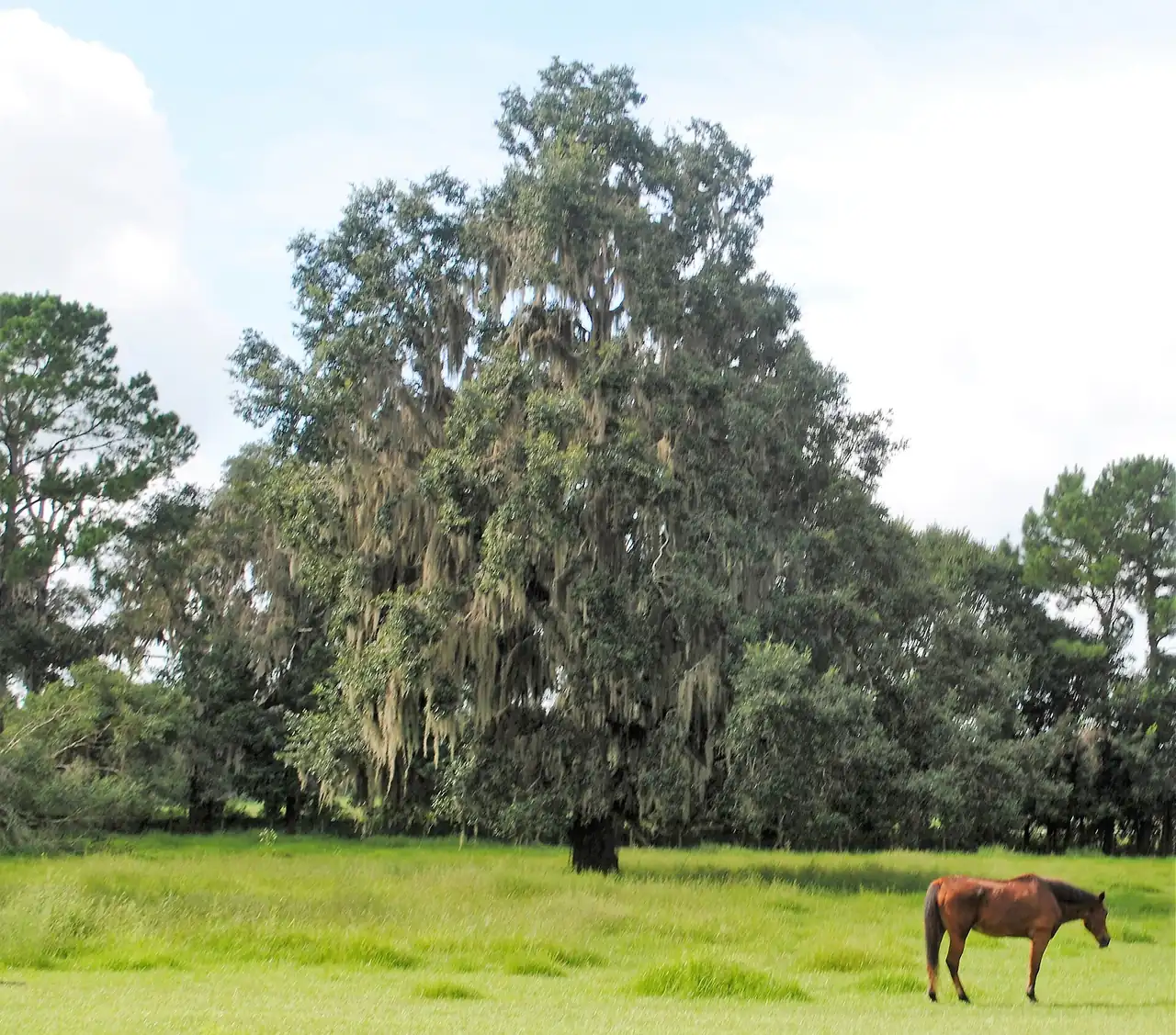
The pro. 1,588 square miles at 237 people per square mile. A national forest covering a large part of the east of the county. Pasture, live oaks, springs, rivers, and a horse industry that keeps large tracts of land in grass rather than in subdivisions. It looks the way people hope Florida will look and mostly does not.
The con. Everything is a drive. There is no transit worth the name, the mean commute is 26.8 minutes, and a household with two working adults needs two cars, two insurance policies and two fuel budgets. Groceries are a drive. Specialists are a drive. An airport is a longer drive.
The judgment. If the driving is a deal-breaker, so is the county, because the low density is the thing producing the countryside.
Inland, which is also no coast
The pro. No coastline means no storm surge, and the National Hurricane Center identifies storm surge and large waves as the greatest threat to life and property along the coast. No evacuation decision every other September. Housing that is not priced for a waterfront.
The con. Also no beach. Both coasts are a day trip rather than an afternoon, and if regular salt water is part of who you are, this is the wrong inland county and every other advantage on this page will not fix it.
And inland is not immune: the hurricanes article is clear that the NHC names flooding as the major threat for people living inland, and that the realistic inland hurricane experience is several days without power in the heat.
The weather, both halves
The pro. Winter. It is the reason the county's population is 29.7 percent aged 65 and over. November through March here is genuinely lovely, and if you are arriving from a place where winter is a five-month siege, this alone can carry the whole decision.
The con. Summer, which is long. Air conditioning is not optional, which is why Florida households average 1,104 kilowatt-hours a month against a national 863 — a 28 percent difference in consumption, at a per-unit price that is actually below the national average. The afternoon storms are near-daily and loud.
The judgment. Most people trade the summer for the winter willingly and say so after a year. A minority find the summer genuinely unbearable and leave. There is no way to know which you are without living through one.
The growth, which cuts both ways
The pro. A county growing 17.8 percent in five years, against 8.9 percent for Florida, is a county where things are opening rather than closing. Services, healthcare capacity and retail follow population.
The con. The roads did not grow 17.8 percent. Traffic on the main corridors is visibly worse than it was, construction is constant, and the county's small-town character is being tested in the places that are growing fastest.
The judgment. This one is a genuine unknown rather than a trade-off, and anybody who tells you confidently how it resolves is guessing.
Two things that are just costs
Not trade-offs. Costs.
Homeowners insurance. This is the most common way a Florida housing budget turns out to be wrong. It is not a small line and it is not predictable from anywhere else you have lived. Get real quotes on the real address during the inspection period; what actually drives your Florida home insurance premium explains which features move the number.
Wildlife and insects. Not a crisis, and genuinely an adjustment. There are more of both here, they are larger, and some of them come indoors. People deal with it and it is on the list because pretending otherwise would be dishonest.
The things that will not change, and the things that might
Worth separating when you weigh this.
Permanent, because they are geography: inland with no coast, low density, a national forest to the east, springs and rivers, the horse industry's hold on the land, the summer, the winter.
Contingent, because they are economics or policy: the wage level, the traffic, the insurance market, what gets built where, how the growth is absorbed.
If the permanent list suits you and the contingent list worries you, that is a reason to move here with your eyes open. If the permanent list does not suit you, no improvement in the contingent one will help.
Sources
- U.S. Census Bureau QuickFacts — Marion County, Florida, and comparison counties — population and growth; 29.7 percent aged 65 and over; 18.0 percent under 18; median household income $61,010; median home value $243,100; owner-occupancy 77.5 percent; mean commute 26.8 minutes; broadband subscription 91.1 percent. ACS figures are 2020-2024 five-year estimates in 2024 dollars (retrieved September 18, 2026)
- U.S. Energy Information Administration — 2024 average monthly residential bill by state — Florida 1,104 kWh a month at 14.14 cents, $156.09; United States 863 kWh at 16.48 cents, $142.26 (retrieved September 18, 2026)
- HUD — Fair Market Rents, FY2026 — Ocala MSA two-bedroom $1,373; Orlando $1,972; Miami-Dade $2,436 (retrieved September 18, 2026)
- National Hurricane Center — Hurricane Preparedness: Hazards — storm surge is the greatest threat along the coast; inland flooding is the major threat for people living inland (retrieved September 18, 2026)
- USDA Forest Service — Ocala National Forest — the national forest occupying a large part of eastern Marion County (retrieved September 18, 2026)
- U.S. Bureau of Labor Statistics — Ocala, FL MSA unemployment rate — 5.8 percent, July 2026, preliminary (retrieved September 18, 2026)
Common questions
What are the disadvantages of living in Ocala?
The honest short list: a local wage level below the Florida median, no practical way to live without a car, summer heat and humidity that runs for about half the year, homeowners insurance costs that surprise people arriving from other states, and a small-city level of restaurants, culture and specialised services. Growth is also adding traffic to corridors that were built for a smaller county.
Is Ocala a good place to raise a family?
That depends on things this site deliberately does not rank. What it can say factually: 18.0 percent of the county's population is under 18 against 18.9 percent for Florida, the owner-occupancy rate is 77.5 percent, and housing costs about a third less than the state median. School performance is published by the Florida Department of Education and the district, and those are the sources to read rather than anyone's summary of them.
What is summer really like in Ocala?
Long. Air conditioning runs most of the year, which is why the average Florida household buys 1,104 kilowatt-hours of electricity a month against a national average of 863. Afternoon thunderstorms are near-daily through the summer months and violent for short periods. People adapt by doing outdoor things early and late, which works, and it is still an adjustment if you are coming from a northern climate.
Is traffic bad in Ocala?
It is worse than it was, on specific corridors, at specific times. The county grew 17.8 percent between 2020 and 2025, which is roughly twice the state rate, and the main roads did not grow 17.8 percent. The mean commute is 26.8 minutes, close to the Florida figure of 28.0, so this is not a big-metro traffic problem — it is a small-county road network absorbing growth.
Should I move to Ocala or somewhere else in Florida?
Weigh it on three things: housing cost, job market and coast access. Ocala wins decisively on the first, loses on the third, and on the second depends entirely on your field. If you need to be near salt water regularly, this is the wrong county and no amount of housing saving fixes that.