Areas and neighborhoods
Living in Downtown Ocala and the historic district
Downtown Ocala is the county's only walkable neighbourhood, and the houses around it are its oldest. Both of those facts come with consequences a newer subdivision does not have.
Bottom line
- It is the only part of the county where you can live without driving for everything, and that is genuinely rare here — 77.5 percent of Marion County households own their home and 26.8 minutes is the county's mean commute.
- The housing stock is old, which in Florida is an insurance question before it is a charm question. Roof age, construction type and opening protection are the first things an underwriter asks about.
- Parcels here sit in Ocala city taxing districts at 17.3710 to 19.0895 mills, against 15.5833 for unincorporated county — several mills more, for city services.
In a county of 1,588 square miles at 237 people per square mile, downtown Ocala is the anomaly: a few blocks where the ordinary business of life is within walking distance. That is the whole appeal, and everything else about living there follows from it.
What is actually there
The square is the centre of it — a public space with a gazebo, ringed by low brick storefronts, restaurants and public buildings. A farmers market, the library, the courthouse, municipal offices, and a small but genuine evening scene.
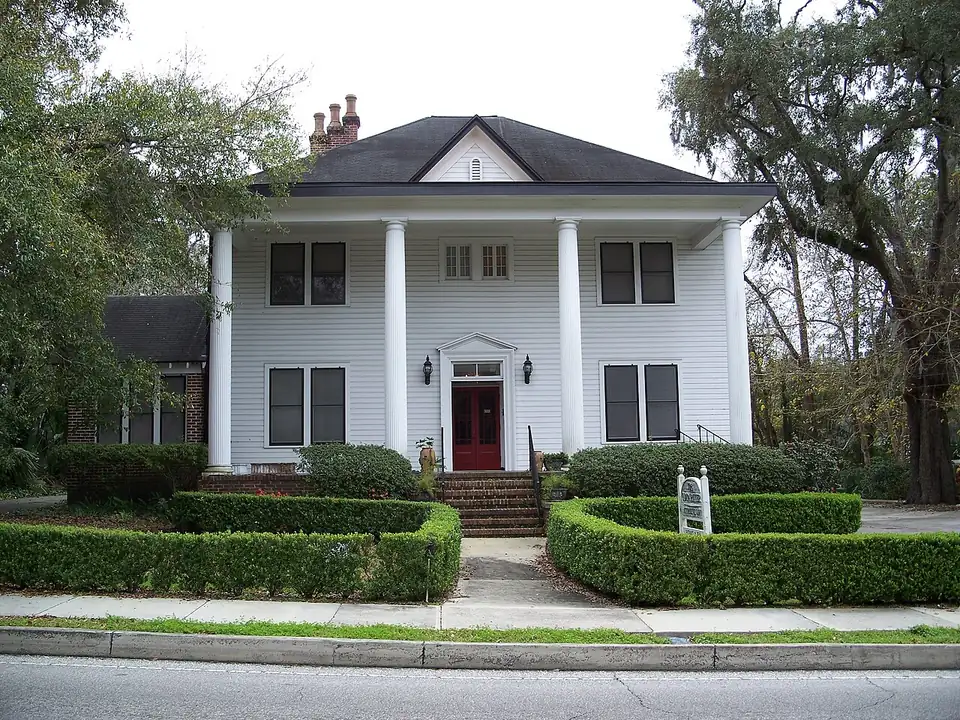
Around it, the historic district: Ocala's oldest surviving housing, a mixture of frame Victorian, early-twentieth-century brick, and infill from every decade since, under a canopy of mature oaks. The streets are narrow by Florida standards and shaded in a way that newer parts of the county are not, because the trees have had a hundred years.
The practical shape of living there is genuinely different from everywhere else in Marion County. You can walk to dinner. You can walk to the library. Your neighbour's house is thirty feet away rather than three hundred.
What it costs, and where
Parcels here sit in Ocala city taxing districts, which is several mills above unincorporated county:
| 2026 proposed millage | Rate |
|---|---|
| Unincorporated county, east of Interstate 75 | 15.5833 |
| Ocala, lowest city district | 17.3710 |
| Ocala, other city districts | 18.8409 – 19.0042 |
| Ocala, highest city district | 19.0895 |
The spread between the unincorporated rate and the top city rate is about 3.5 mills — roughly $875 a year on a $250,000 taxable value. You are buying city services with it: city police, city utilities in most cases, and the street maintenance that makes a walkable district walkable.
On purchase prices, the county-wide median of $243,100 is not a useful guide here in either direction. The historic district is a small, unusual and variable segment of the market, and a median across 205,732 housing units tells you nothing about a hundred-year-old house on a shaded street.
The two consequences of old housing
Insurance is the first one
This is the part that catches buyers who fall for the house before they price it.
Florida insurers underwrite on roof age, roof covering, roof deck attachment, roof-to-wall connection, roof geometry and opening protection, and older houses tend to score worse on all of them unless work has been done and — crucially — documented. Section 627.711 of the Florida Statutes requires insurers to disclose the discounts available for windstorm mitigation features, which is only useful if somebody has evidenced the features.
Practical sequence for any older house here:
- Ask the roof's age and material before you offer.
- Get a wind mitigation inspection and hand the form to every carrier.
- Get real quotes during the inspection period, not estimates afterwards.
What actually drives your Florida home insurance premium goes through the whole of it.
Historic designation is the second
A locally designated historic district typically carries review of exterior changes visible from the street: windows, siding, roofing material, porches, additions, sometimes colour. That is the mechanism that keeps the district looking the way the district looks, and it is the reason people want to live there.
It is also a real constraint on what you can do to your own house, and the details vary. Whether a specific parcel is inside a locally designated district, and what that designation requires, is a question for the city rather than something to guess from the street. If you intend to change anything outside — and replacing a roof or a window counts — ask before you are under contract rather than after.
Note that being in a historic district is a different thing from being in a homeowners' association or under recorded deed restrictions, and a parcel can be in more than one of the three. HOA basics for Florida buyers covers the second and third.
The trade-offs, stated plainly
What you get: walkability that exists nowhere else in the county, mature trees, architecture with some history in it, and proximity to the courthouse, the library and the market.
What you give up: land. Lots are small by Marion County standards, and if acreage, a workshop or a paddock is on your list, this is the wrong part of the county entirely.
What you take on: an older building, in a climate that is hard on buildings, with an insurance market that prices old roofs unsentimentally. That is manageable and it is not free.
What varies: evening activity, street by street. Downtown at eight on a Saturday and downtown at eight on a Tuesday are different places, and both are worth seeing before you decide.
Schools and crime, as everywhere on this site
School assignment is by attendance zone, set by address. Confirm the zone with the district for the exact parcel; a historic district address does not imply a particular school.
Performance is published by the Florida Department of Education. Crime data is published by FDLE, the Marion County Sheriff's Office and the Ocala Police Department. This site links those sources and does not rank, summarise or characterise, here or anywhere else — the reasoning is on the editorial policy page.
Sources
- Marion County Property Appraiser — Property Tax Estimator — 2026 proposed millage: Ocala city districts 17.3710, 18.8409, 19.0042 and 19.0895 mills; unincorporated county east of Interstate 75 15.5833 mills. The page states it excludes non-ad valorem assessments (retrieved September 18, 2026)
- Marion County Property Appraiser — parcel records: taxing district, year built, assessed value and exemptions (retrieved September 18, 2026)
- U.S. Census Bureau QuickFacts — Marion County, Florida — owner-occupancy 77.5 percent; mean travel time to work 26.8 minutes; 236.7 people per square mile; 442,660 people July 2025. ACS figures are 2020-2024 five-year estimates in 2024 dollars (retrieved September 18, 2026)
- Florida Statutes section 627.711 — Notice of premium discounts for hurricane loss mitigation — the windstorm mitigation features insurers price and must disclose discounts for (retrieved September 18, 2026)
- FDLE — Uniform Crime Reports — the official source for Florida crime data; this site links it and characterises no area (retrieved September 18, 2026)
- Marion County Sheriff's Office — county-level crime information (retrieved September 18, 2026)
- Florida Department of Education — school grades — the official source for school performance; this site links it and does not rank schools (retrieved September 18, 2026)
Common questions
Can you walk anywhere in Ocala?
Downtown, yes — the square and the streets immediately around it are the one genuinely walkable part of Marion County, with restaurants, a farmers market, shops and public buildings within a few blocks. Everywhere else in the county is car-dependent, which makes downtown unusual here rather than ordinary.
Is downtown Ocala safe?
This site does not characterise areas as safe or unsafe, anywhere, and the reasons are on the editorial policy page. Crime data for the county is published by FDLE and the Marion County Sheriff's Office, and city data by the Ocala Police Department. Those are the sources; read them directly rather than anyone's summary.
What does living in a historic district mean for renovations?
Locally designated historic districts typically carry review of exterior changes visible from the street — windows, siding, roofing material, porches, additions, sometimes paint. Whether a specific parcel is inside a locally designated district, and what that designation binds you to, is a question for the city rather than something to infer from the neighbourhood's appearance. Ask before you buy if you plan to change anything outside.
Are older houses harder to insure in Florida?
Often, and the reason is specific: Florida insurers price roof age, roof deck attachment, roof-to-wall connection and opening protection, and an older house tends to score less well on all four unless work has been done and documented. Section 627.711 of the Florida Statutes requires insurers to disclose the discounts available for those features. Get a wind mitigation inspection and real quotes during the inspection period.
Is downtown Ocala more expensive than the rest of the county?
Parcels there are in Ocala city taxing districts, which run several mills above the unincorporated county rate — 17.3710 to 19.0895 against 15.5833 — and that is a real annual difference on the same taxable value. On purchase price, the historic district's houses are a small and unusual part of the market and the county-wide median of $243,100 does not describe them well in either direction.